Quality Spare Parts & Sealants Matter for Long-Term Performance
28 Apr, 2026

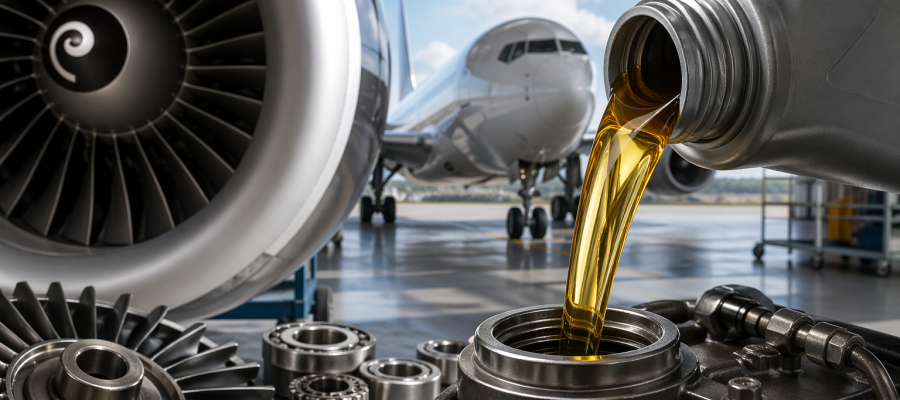
Hey there, aviation enthusiast, industry pro, or curious traveler. Have you ever looked up at a jet streaking across the sky and thought about the thousands of components working in perfect, silent harmony? Probably not. Most of us think about the wings, the engines, or the pilot’s cool sunglasses. But let me let you in on a little secret—the unsung hero of every safe flight is something you probably never see: advanced oils.
I’m not talking about the conventional motor oil you’d buy for your old pickup truck. I’m talking about high-performance, chemically engineered, almost-magical fluids that keep a 500-ton machine from tearing itself apart at 35,000 feet.
At Global Airparts & Lubricants, we’ve seen firsthand how the shift from standard lubricants to advanced synthetic oils has revolutionized maintenance schedules, safety records, and fuel efficiency. Whether you’re a mechanic, an engineering student, or a frequent flyer, understanding why these oils matter will change the way you look at aviation.
So, grab a coffee (or jet fuel, if that’s your thing), and let’s dive into the slippery, high-stakes world of aerospace lubrication.
The Naked Truth: Why Standard Oils Fail at 30,000 Feet
Let’s start with a brutal fact. If you poured standard, off-the-shelf motor oil into a turbine engine, you’d be lucky to get ten minutes of flight time before catastrophic failure. Why? Because standard oils are designed for Earth-bound conditions. They hate extreme cold, they cook under high heat, and they turn into sludge when stressed.
In aerospace, we deal with temperature swings from -65°F in the upper atmosphere to over 400°F inside a turbine bearing. Conventional oils oxidize, evaporate, or solidify in these ranges. That’s where advanced oils come in. These are not just "better" oils; they are entirely different chemical beasts. They are designed to maintain viscosity, resist oxidation, and protect metal surfaces under conditions that would turn regular oil into tar.
From Castor Beans to Chemistry: A Quick History
Believe it or not, early aircraft engines in World War I used castor oil. Yes, the same stuff you might take for constipation. It worked okay for rotary engines, but it gummed up, smelled terrible, and wasn’t exactly reliable.
Fast forward to the jet age. Engineers realized that mineral oils were useless for jet engines. The 1950s saw the birth of synthetic esters—man-made molecules designed from the ground up for stability. Today, the oils used in a Boeing 787 or an Airbus A380 share almost nothing with those early lubricants. They are often based on polyalphaolefins (PAOs) or complex esters, crafted in clean rooms, not refineries.
Global Airparts & Lubricants has watched this evolution closely. We’ve moved from simple greases to nano-engineered fluids that can actually "heal" micro-fractures in metal surfaces under pressure. That’s not magic; that’s chemistry.
The Four Superpowers of Advanced Aerospace Oils
What makes an oil "advanced" in an aviation context? It’s not just one thing. It’s a package of four critical superpowers that every maintenance crew relies on.
1. Thermal Stability: Dancing with Fire
Turbine engines are essentially controlled explosions. The oil in a bearing housing sits right next to components hot enough to melt aluminum. Standard oil would break down, form varnish, and clog tiny oil jets. Advanced oils have synthetic base stocks and anti-oxidant additives that allow them to survive continuous high heat without coking (that’s the black, crusty carbon deposit you never want to see).
2. Low-Temperature Fluidity: The Cold Start
An aircraft parked overnight in Anchorage, Alaska, or a military drone at high altitude faces a brutal problem: gelled oil. If the oil becomes too thick, it won’t flow to the bearings on startup. The result? Metal-on-metal grinding. Advanced oils use pour-point depressants and low-viscosity synthetics that flow like water even at -50°F, ensuring immediate lubrication.
3. Extreme Pressure (EP) Protection
Gearboxes, actuators, and landing gear hinges experience massive shock loads. Think of a landing gear dropping into place at 200 mph. Advanced oils contain EP additives—usually phosphorus or sulfur compounds—that form a sacrificial film on metal surfaces. When the pressure spikes, that film takes the hit, not the gear teeth.
4. Compatibility with Seal Materials
Here’s a hidden killer: many oils swell, shrink, or dissolve rubber seals. In an aircraft hydraulic or oil system, a failed seal means a leak, and a leak at altitude is a disaster. Advanced aviation oils are meticulously tested to be compatible with fluorocarbon, nitrile, and silicone seals found in modern aircraft.
Gas Turbine vs. Piston: Not All Oils Are Created Equal
One of the biggest mistakes a new maintenance technician can make is thinking "oil is oil." In aviation, we have two completely different worlds.
Jet Engines (Gas Turbines): These require low-viscosity, high-stability synthetics, typically meeting military specifications like MIL-PRF-23699 or commercial specs like SAE AS5780. These oils are thin, almost like water when hot, because they need to flow through tiny nozzle spray bars inside the engine. Global Airparts & Lubricants stocks a range of these, from Type II to high-thermal-stability variants.
Piston Engines (General Aviation): Think Cessnas, Pipers, and old Warbirds. These still often use ashless dispersant (AD) oils—either mineral or semi-synthetic. But even here, "advanced" means multi-grade oils (like 15W-50 or 20W-60) that reduce lead fouling from avgas and keep the engine cleaner for longer.
Don’t swap them. Putting a jet oil into a piston engine will cause massive wear (too thin). Putting piston oil into a jet will cause coking and fire risk (too thick, wrong additives).
The Silent Cost Saver: Fuel Efficiency and Extended TBO
Here’s where it gets interesting for accountants and flight operations managers. Advanced oils don’t just protect engines;they save money. How? Reduced friction.
When an engine’s bearings and gears spin with less internal resistance, the turbine doesn’t have to work as hard to maintain RPM. That translates directly into lower specific fuel consumption (SFC). Major airlines have reported fuel savings of 0.5% to 1.5% simply by switching from standard-approved oils to higher-performance, advanced synthetic blends. On a fleet of 100 aircraft, that’s millions of dollars annually.
Moreover, advanced oils extend Time Between Overhauls (TBO). Because they resist varnish and sludge, the engine internals stay cleaner. You can push that engine another 500, 1,000, or even 2,000 hours before pulling it apart. For a cargo operator or an airline, that means fewer grounded aircraft and more revenue flights.
Real-World Applications – Where the Rubber (and Oil) Meets the Sky
Let’s get specific. Where are these advanced oils actually used on an aircraft? You might be surprised.
Main Engine Lubrication
The obvious one. A single GE90 engine on a Boeing 777 holds about 5–6 gallons of oil. That oil circulates through the engine, cools the bearings, lubricates the gearbox, and even helps cool the turbine disc. It’s a closed-loop system, but it still consumes oil slowly (normal loss is about 1 quart per hour for some large engines).
Auxiliary Power Unit (APU)
The APU is that little turbine in the tail. It runs on the ground and in flight for electrical power. It has its own oil sump, often using the same advanced oil as the main engines. If that APU oil fails, you lose all backup power.
Gearboxes and Transmissions
Helicopters are oil-dependent beasts. The main transmission of a Sikorsky or an Airbus helicopter uses advanced gear oils that handle both high speed and shock loading. A failure here is a loss of rotor drive—non-negotiable.
Actuators and Landing Gear
Many modern aircraft use electro-hydrostatic actuators (EHAs) filled with advanced hydraulic fluids (often a type of synthetic oil). These operate flight controls and landing gear retraction. The oil must be fire-resistant and stable across temperature ranges.
The Certification Minefield: Why You Can’t Just Buy Any Oil
If you’re a maintenance director at an MRO (Maintenance, Repair, and Overhaul) facility, you know the pain. You can’t just walk into an auto parts store. Aerospace oils must meet rigorous specifications.
The big three you’ll see are:
Then you have OEM approvals. Rolls-Royce, GE, Pratt & Whitney—each publishes a list of approved oils. Global Airparts & Lubricants ensures that every drum we ship has the correct certification traceability. You can’t fake a batch number in this industry; lives depend on it.
Maintenance Best Practices – Handling Advanced Oils Like a Pro
So you’ve got the best advanced oil on the planet. Great. But if you mishandle it, you might as well be pouring in sand. Here’s the friendly but firm advice from our team at Global Airparts & Lubricants.
1. Never Mix Brands Without Verification
Different advanced oils use different additive packages. Mixing a MIL-PRF-23699 Type I with a Type II can cause additive incompatibility, leading to gelling or foaming. Always consult the maintenance manual.
2. Use Dedicated Equipment
Don’t use that old funnel you used for mineral oil. Cross-contamination is a silent killer. Have color-coded, labeled oil servicing carts.
3. Mind the Shelf Life
Yes, advanced oils do degrade. Most have a shelf life of 3–5 years when unopened, stored in a cool, dry place. Heat and humidity degrade the esters. Check the manufacturing date on every drum.
4. Sample and Test
Proactive maintenance means regular oil analysis. Send samples to a lab to check for metal particles, viscosity change, and total acid number (TAN). A rising TAN means the oil is oxidizing and needs changing.
5. Dispose Properly
Synthetic oils are not friendly to the environment. Never dump them. Use licensed waste oil collectors. Many advanced oils are classified as hazardous waste due to additives.
The Future: Smart Oils and Condition-Based Monitoring
Here’s where we get futuristic. What’s next for advanced oils in aerospace? We’re already seeing the first generation of "smart" lubricants.
Imagine an oil that contains microscopic sensors—particles that change color or electrical conductivity when the oil degrades. Or oils with nano-additives like hexagonal boron nitride (hBN) or graphene that
create near-zero friction surfaces. Research labs are testing self-regenerating oil films that can fill microscopic wear scars.
At Global Airparts & Lubricants, we’re also tracking the move toward condition-based monitoring (CBM). Instead of changing oil every 500 hours by the clock, airlines are starting to change oil based on real-time data from onboard sensors. This reduces waste, cuts maintenance downtime, and improves safety.
And let’s not forget sustainable aviation. Bio-based synthetic esters (derived from plants, not petroleum) are becoming viable. They offer biodegradability for over-wing engine oil leaks, which is a huge environmental win.
Case Study – How the Right Oil Saved a Fleet
Let me tell you a quick, anonymized story. A regional cargo carrier operating turboprops in northern Canada was experiencing premature bearing failures every 1,200 hours. The cost was enormous—downtime, parts, and lost cargo revenue.
Their maintenance team was using a standard MIL-PRF-23699 oil. But the issue wasn’t the spec; it was the cold. At -40°F, the oil was too thick on startup, causing cavitation in the oil pump and starving the rear bearing.
We at Global Airparts & Lubricants recommended a switch to a lower-viscosity MIL-PRF-7808 synthetic oil designed for Arctic conditions. The result? Zero bearing failures over the next 3,000 hours per engine. The oil flowed instantly at cold starts, and the pump cavitation vanished.
That’s the difference advanced oils make—not on paper, but in the real, freezing, unforgiving world.
Common Myths About Aviation Oils (Busted)
Let’s clear up some misconceptions floating around hangars and online forums.
Myth 1: "Synthetic oil causes leaks."
Fact: Old mineral oils could shrink seals. Modern synthetics are formulated to be seal-friendly. If a synthetic oil leaks, the seal was already failing.
Myth 2: "You can stretch oil change intervals if the oil looks clean."
Fact: Oil degrades chemically long before it looks dirty. Clear oil can have a high total acid number. Follow the schedule, not your eyes.
Myth 3: "All MIL-PRF-23699 oils are identical."
Fact: No. There are multiple sub-specs (Class I, II, III, HTS). Always verify the exact type required by your engine manual.
Myth 4: "Grease is grease – use it on anything."
Fact: Wheel bearing grease is different from flight control grease is different from instrument grease. Use the wrong grease, and you could get cold-stiffening or melting. Global Airparts & Lubricants always advises: read the maintenance manual first.
Choosing a Supplier: Why Global Airparts & Lubricants Stands Apart
You might be thinking, "Okay, I’m convinced about advanced oils. Where do I buy them without getting counterfeit products?" Excellent question.
The aerospace lubricant market has a dark side: counterfeits. There are documented cases of drums labeled as Mobil Jet Oil II that actually contained cheap hydraulic fluid. Using that in an engine would be catastrophic.
Here’s what you need from a supplier—and what Global Airparts & Lubricants delivers every day:
A Step-by-Step Guide to Switching to Advanced Oils
If you’re still using older mineral or semi-synthetic oils in your GA aircraft or helicopter, here’s how to make the switch safely.
Step 1: Consult Your Manual
Ensure your engine or gearbox manufacturer approves the advanced synthetic oil you want to use. Some older engines (like certain radial engines) are not compatible.
Step 2: Flush the System
Don’t just top up. Drain the old oil completely. For engines, you may need to run a flushing oil or perform a short ground run, then drain again. Old mineral oil residue can react badly with new synthetics.
Step 3: Change the Filters
Install new oil filters after the flush. Old filters contain sludge and particles from the previous oil.
Step 4: Fill and Monitor
Fill with the new advanced oil. Run the engine and check for leaks (synthetics find weak seals quickly). Perform an oil analysis after the first 25 hours to establish a baseline.
Step 5: Adjust Your Maintenance Schedule
Advanced oils often allow longer change intervals. But don’t extend intervals without lab confirmation. Work with your maintenance provider.
Environmental Considerations: Spills, Disposal, and Biodegradable Options
We can’t ignore the green side of aviation maintenance. While advanced synthetic oils perform better, many are not biodegradable. A hydraulic or oil leak on the ramp can contaminate soil and groundwater.
That’s why the industry is developing environmentally acceptable lubricants (EALs) for applications where spills are likely—such as hydraulic fluids for landing gear and flight controls. These EALs are typically based on synthetic esters that break down in weeks, not decades.
However, EALs often have lower thermal stability. For turbine engines, the main lubrication oil remains non-biodegradable for now. So, best practices include:
Global Airparts & Lubricants offers a take-back program for used oil drums in many regions, promoting circular economy principles.
The Financial Argument – Advanced Oils as an Investment
Let’s talk dollars and cents, because at the end of the day, airlines and operators need ROI.
An advanced synthetic oil might cost 2–3 times more per gallon than a basic mineral oil. But the total cost of ownership is lower. Here’s why:
We’ve run the numbers for clients. A small fleet of five regional jets can save over $50,000 annually by switching to high-thermal-stability advanced oils and extending oil change intervals based on analysis.
Emergency Situations – When Oil Becomes a Lifesaver
Here’s a sobering thought. In an emergency, like a loss of main engine oil pressure, some advanced oils offer a "dry-run" capability. Certain synthetic formulations can provide up to 30–60 seconds of lubrication even after the oil supply is cut, thanks to boundary lubrication additives that cling to metal surfaces.
That minute could be the difference between a safe landing and a fire. Military engines often specify oils with enhanced extreme-pressure and anti-weld properties specifically for battle damage scenarios. Commercial aviation benefits from the same chemistry.
At Global Airparts & Lubricants, we take pride in knowing that every drum we ship might one day be the reason an aircraft makes it home.
Conclusion: Don’t Cut Corners on What You Can’t See
Look, I get it. Maintenance budgets are tight. There’s always pressure to save a few bucks on consumables like oil. But if there’s one takeaway from this very long (but hopefully fascinating) post, it’s this: advanced oils are not an accessory. They are a critical flight-safety component, just like the landing gear or the avionics.
From the extreme cold of a polar route to the scorching heat of a desert takeoff, these engineered fluids protect your engine, your passengers, and your bottom line. Whether you’re flying a Piper Cub or commanding a fleet of A380s, using the right advanced oil—from a trusted supplier like Global Airparts & Lubricants—is one of the smartest decisions you can make.
So next time you see a plane climbing into the sky, give a little nod to the oil inside. It’s doing more work than you’ll ever know.
Have questions about which advanced oil is right for your aircraft? Reach out to our team at Global Airparts & Lubricants. We’re always happy to talk shop—no jargon, just honest advice.

18 Apr, 2026
21 Jan, 2026

14 Jan, 2026

10 Jan, 2026

03 Jan, 2026
16 Dec, 2025
09 Dec, 2025

12 Sep, 2025
Efficient and reliable delivery of goods or products within a minimal timeframe, often prioritizing before delivery time.
A secure payment system (SPS) is a way to protect financial transactions and personal data from fraud and unauthorized access.
"24/7 support" means providing customer assistance around the clock, 24 hours a day, 7 days a week, ensuring customers can get help whenever they need it.